A recent news article piqued my interest in a potential hazard for librarians handling Victorian era books with Emerald green book covers – arsenic contamination from dyes once used to produce a brilliant green hue, most especially in cloth book bindings.
About five years ago, Dr. Melissa Tedone identified friable arsenic while repairing the cloth binding of a book at the Winterthur Library. In response, she and Dr. Rosie Grayburn, both of whom are affiliated with the Winterthur Museum, Garden & Library and the University of Delaware, established the Poison Book Project.
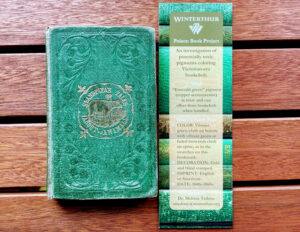
The Project’s website contains a frequently updated database of books (now in excess of 300) that were found to contain arsenic in their cloth covers or in such locations as end papers, text block edges, paper covers and labels, and leather inlay. The website offers guidance on how to handle those books and dispose of arsenic contaminated waste material. In addition, it provides instructions on how researchers can obtain a color swatch bookmark for use in determining whether a book may contain arsenic.
As I learned from my research, museum conservators face an even greater array of contaminant challenges. For example, tin-mercury mirrors can emit mercury vapors, and even old Fiesta Ware may have a radioactive uranium glaze. To address such hazards, the American Institute for Conservation (“AIC”) has established a Health & Safety Network that provides educational and technical information, including a pigment toxicity chart and a sample risk management plan checklist for pesticide residues, as well as references to materials about relevant OSHA, NIOSH, and EPA requirements. Such information is particularly valuable as there appears to be little online guidance from federal or state agencies on the risks posed by toxic materials like arsenic and other heavy metals in books or museum artifacts.
Moral of the story: While it may be wise to avoid an offer of elderberry wine from elderly spinsters like those portrayed in “Arsenic and Old Lace”, it’s perhaps even more important to avoid handling a Victorian era book with a bright green cover until after you’ve reviewed the Poison Book Project’s website and perused at least the introductory sheet of health and safety information that is available online from the AIC Health & Safety Network. And as cautioned by Dr. Tedone in one video, don’t lick that book!