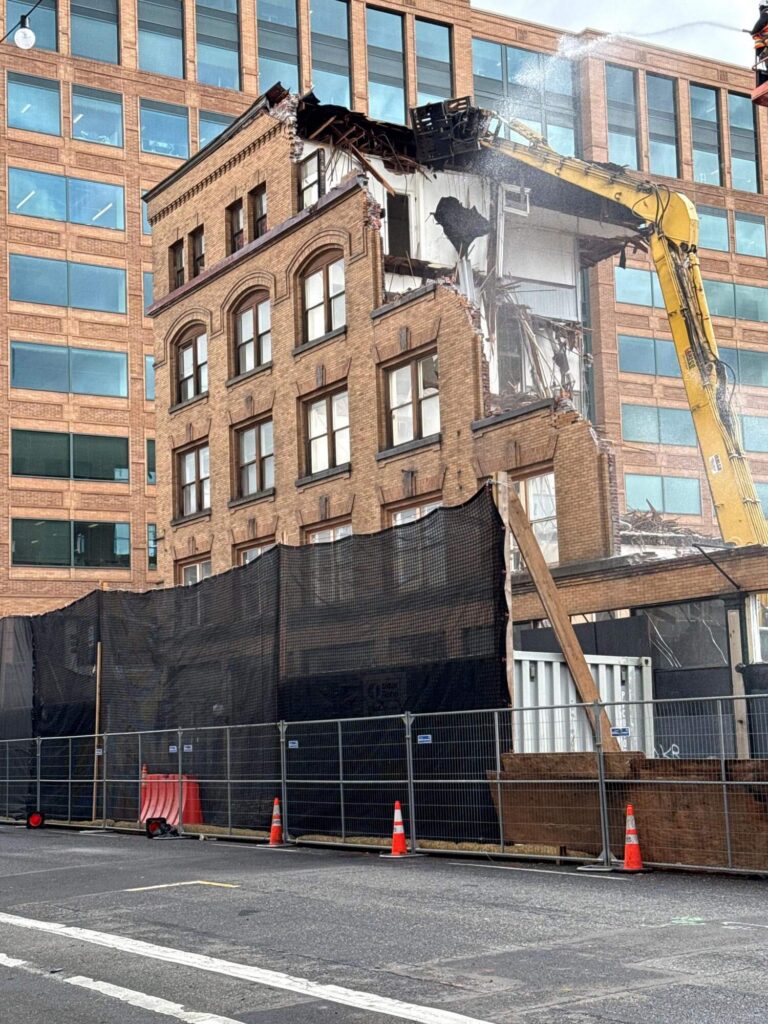
Just down the block from my office in Portland, an enormous set of jaws has been steadily devouring an elegant, slightly time-worn building. Very soon, the 1906 Governor Building, until recently the home of performance artists, a tattoo parlor and an iconic record store, will be reduced to a giant pile of bricks, plaster, wood, glass, insulation, wiring, paint, and maybe some old concert posters.
The Oregon Department of Environmental Quality (DEQ) wants to rethink construction and demolition practices to reduce exposure to toxics in building materials. DEQ estimates that nearly one third of Oregon’s landfill-bound waste is construction and demolition waste. DEQ’s Reuse, Reduce, Reimagine Grants Program is providing up to $2 million in 2026 grant funding for projects that might keep harmful materials out of new buildings or at least minimize how much of those materials end up in landfills.
DEQ’s Materials Management Grant program has been around in various forms since the early 1990s. Grants are funded by landfill tipping fees. At the beginning, the program focused on recycling and disposal and primarily funded projects by local governments. In 2024, the program was relaunched to promote more “upstream” efforts to minimize toxic materials at earlier points in a product’s life cycle and to involve nonprofits, small businesses and local communities. The objectives of the grant program include “inspire[ing] promising solutions to reduce the impacts of materials by funding innovative projects and programs” and “creat[ing] environmental and health benefits that result from more sustainable consumption and use of materials.” Reduce, Reuse, Reimagine Grants now have a dedicated funding priority for each two-year grant cycle. Projects by previous grant recipients include reusable dishware for community events, establishment of a community tool library, and equipment to repair, refurbish and resell used computers.
The 2026 annual funding area is “Built for Well-Being: Reducing Exposure to Toxic Substances in Building Materials.” DEQ is asking grant applicants to focus on projects that minimize exposure to six classes of chemicals often present in building materials:
- PFAS (found in materials used for water and stain resistance)
- Antimicrobials (added to kill germs or prevent mold)
- Flame retardants (found in furniture and electronics)
- Bisphenols and phthalates (used in plastic and vinyl)
- Solvents (found in paint and adhesives)
- Heavy metals, including lead, mercury and cadmium.
However, other creative ideas for managing or eliminating toxics in the built environment will be considered. DEQ’s examples for possible projects include:
- Developing guides and toolkits to help homeowners choose healthier materials
- Changing design or purchasing rules to prefer safer materials
- Creating materials libraries showcasing healthier products
- Contractor education programs
- Researching and testing alternative building materials
- Starting programs to carefully take apart old buildings and avoid spreading toxic materials like asbestos and lead-based paint
- Establishing manufacture take-back programs.
Local governments, nonprofit organizations, Tribal Nations, public schools, public universities, community colleges and small businesses are eligible for the grants. Individual grants will range from $25,000 to $225,000, and $500,000 of grant money will be set aside for Tribal Nation projects. Pre-applications for the grants are due April 30, and the recipients will be announced in late 2026.
The Governor Building will be long gone by then. It’s not at all clear why this beloved old space was pulled down or what, if anything, was rescued from the rubble and found a new home. Perhaps DEQ’s Reduce, Reuse, Reimagine grants will make whatever rises in its place a safer, more sustainable place to live, work, and shop for records.