December 3, 2024 marks the 40th anniversary of the worst industrial accident in history. Explosions at a pesticide manufacturing plant in Bhopal, India, released deadly methyl isocyanate into the night air, killing thousands of people instantly and injuring hundreds of thousands more. The plant was owned by Union Carbide India Limited (UCIL), a company majority-owned by the U.S. chemical giant Union Carbide.
Following the accident, U.S. tort lawyers descended on India, seeking to represent victims and their families. In 1985 India adopted the Bhopal Gas Leak Disaster Act that allowed the government of India to take over representation of the victims. At the request of the Indian government, U.S. courts then diverted all litigation to India. In 1989 Union Carbide and UCIL agreed with the government of India to settle the claims for the remarkably low sum of $470 million.
In July 2024 three of my students and I traveled to India to participate in the annual colloquium of the IUCN Academy of Environmental Law at the Gujurat National Law University in Gandhinagar. I arrived a day early in order to visit Bhopal. Previous visits to the sites of the Chernobyl and Fukushima nuclear disasters taught me that one could learn a great deal from personal site visits.
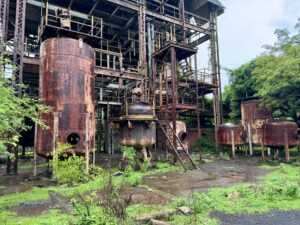
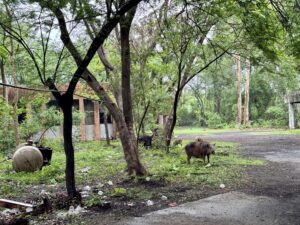
The 93-acre site where the Union Carbide plant had been is surrounded by poor, residential neighborhoods. What I found when I ventured on the site was astonishing. The first thing I observed was wild boars roaming the decaying remains of the abandoned plant. Twisted metal from the initial tank explosion remains (see photo above/right) along with the rusting remains of other structures that made up the chemical complex. No evidence of cleanup or decontamination is visible, though the soil is no longer spongy with chemicals as it was when a reporter who ventured onto the site 14 years ago was severely injured by exposure to them.
Locals are convinced that the actual death toll was far greater than government estimates, describing bodies piling up so fast that they were dumped in a nearby river or piled on bonfires. The site is now owned by the government of Maydha Pradesh State which has rebuffed pleas to conduct a thorough cleanup. I came away from my visit thinking that if this disaster had occurred in the U.S., the site would have been the subject of a long-term remedial action under our Superfund program.
Across from the site entrance is the “Mother and Child” statue, erected the year after the disaster occurred. Depicting a woman clutching a child in one hand while covering her face with her other hand, the statue now is fenced off in a way that makes it difficult to appreciate. Locals maintain that families of the victims each received only a few hundred dollars in compensation from the settlement the government of India received. Had the victims’ claims been litigated in the U.S. it is certain they would have received far more.