It’s a big week for environmental law at the U.S. Supreme Court, with Suncor Energy v. Boulder County argued on the First Monday in October 2026, followed by Dept. of the Air Force v. Prutehi Guahan to be argued on Wednesday. Prutehi Guahan presents two basic questions: (1) whether a federal agency’s submission of an application to renew a permit under the Resource Conservation and Recovery Act (RCRA) constitutes “final agency action” for purposes of review under the Administrative Procedure Act; and (2) whether a federal agency must comply with environmental review requirements under the National Environmental Policy Act (NEPA) before submitting a RCRA permit renewal application to a permitting authority for consideration. If all this seems like a dry question of administrative procedure, the case actually provides a striking example of how NEPA remains a critical component of environmental law, even with all the upheaval in NEPA-world. At stake are profound implications for Guam, other U.S. territories, and environmental justice.
The case arises on the Pacific island of Guam, pitting a local nonprofit, Prutehi Guahan, represented by Earthjustice, against the U.S. Air Force, represented by the Solicitor General. As a U.S. territory, Guam hosts strategic U.S. military installations including Andersen Air Force Base on the north end of the island. Adjacent to the base, the Air Force operates a munitions disposal facility at Tarague Beach. Tarague Beach serves as a nesting habitat for sea turtles and resting areas for migratory seabirds. Nearby, local residents gather medicinal plants and engage in subsistence fishing. Tarague Beach also sits above Guam’s sole-source aquifer, which provides drinking water for most of Guam’s population.
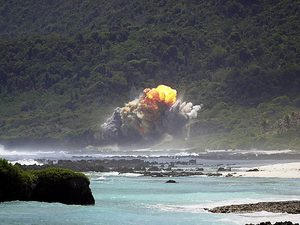
For more than four decades, the Air Force has conducted Open Burning/Open Detonation activities at the Tarague Beach facility. Open burning entails burning waste munitions in the open air. Open detonation involves exploding waste munitions on bare sand. OB/OD operations on Guam have been used to dispose of waste munitions including unexploded ordnance, ammunition, and propellants, some dating back to World War II.
OB/OD operations are hazardous, releasing toxic fumes and hazardous materials into the environment. The potential health impacts from open burning of waste munitions are well known. In 2022, the federal Honoring our PACT Act identified more than two dozen cancers and other diseases that may be presumptively associated with “exposure to burn pits and other toxins.” Even so, the operation of OB/OD units remains legal in the United States and its territories if conducted in accordance with a RCRA permit. The Air Force has held a RCRA permit for OB/OD operations at Tarague Beach since 1982.
In 2019, EPA issued a report identifying a number of available “alternative technologies” that could safely substitute for open burning and open detonation of waste munitions. Nevertheless, the Air Force declined to adopt any of these alternative technologies and submitted a permit renewal application to Guam EPA in 2021 seeking approval to continue OB/OD operations at the Tarague Beach facility.
Like most states, Guam, as a U.S. territory is authorized to administer its own RCRA program. RCRA permits issued by Guam are presumptively valid for three years, subject to administrative extension upon timely receipt of an application for permit renewal. The last RCRA permit for Tarague Beach was issued in 2018. With the permit renewal application submitted by the Air Force in 2021, the 2018 permit continued in effect.
Prutehi Guahan sued the U.S. Air Force in January 2022, arguing that the Air Force violated NEPA by submitting a RCRA permit renewal application without preparing an EIS or EA. The Air Force objects to the lawsuit, for two main reasons.
First, the Air Force argues that submission of a permit application to Guam EPA is not “final agency action” reviewable under the Administrative Procedure Act. The Air Force suggests that submission of its permit renewal application is not a final action but “simply the initial step of an ongoing regulatory process,” one that “entails no meaningful legal consequences until Guam EPA grants or withholds a new permit.” The U.S. district court embraced this argument in dismissing the plaintiff’s complaint. However, the Ninth Circuit Court of Appeals reversed, accepting the plaintiff’s argument that it was the Air Force’s decision to submit the permit renewal application in 2021 that constituted final agency action. That decision had legal consequences. Among other things, it extended the life of the 2018 RCRA permit, which remains in effect today.
Second, the Air Force points to EPA regulations codifying the familiar notion that the RCRA process is a “functional equivalent” of the NEPA process. See 40 C.F.R. § 124.9(b)(6). While this argument appears to weigh heavily in favor of the Air Force, the Ninth Circuit did not consider it dispositive, reversing the district court on this point as well. For one thing, the regulation only applies “when EPA is the permitting authority,” relieving EPA of NEPA analysis when it reviews draft RCRA permits. None of that applies here. Most “critically,” the court pointed out that RCRA and NEPA have distinct timing. NEPA analysis might have compelled the Air Force to consider alternatives to OB/OD at Tarague Beach before preparing the permit renewal application. RCRA analysis, by contrast, would require Guam EPA, as the permitting authority, to evaluate the technical proposal for OB/OD operations on Tarague Beach after the Air Force decides to go forward with the plan. With distinct actors, purposes, and timing, the Ninth Circuit concluded that “RCRA complements, but does not substitute for, environmental review under NEPA.”
More broadly, the case before the Supreme Court raises profound questions for democracy and environmental justice. As one group of amici noted, NEPA has particular importance to the 3.6 million people living in the U.S. territories of Guam, Puerto Rico, American Samoa, the U.S. Virgin Islands, and the Northern Mariana Islands. Although mostly U.S. citizens subject to U.S. sovereignty, territory residents cannot vote for U.S. presidents and have no voting representation in the U.S. Congress. They are also disproportionately impacted by contamination from U.S. military training and disposal activities.
For the people of Guam, left without federal democratic processes to protect their interests, “NEPA is not merely a procedural formality.” Another group of amici based in Guam describes NEPA as “often the only structured opportunity for Guam’s communities to participate in federal decisions that directly affect them.”
However the Supreme Court ultimately rules in Prutehi Guahan, we can certainly say there is a lot at stake here, for Guam, for U.S. territories, and for democracy itself.