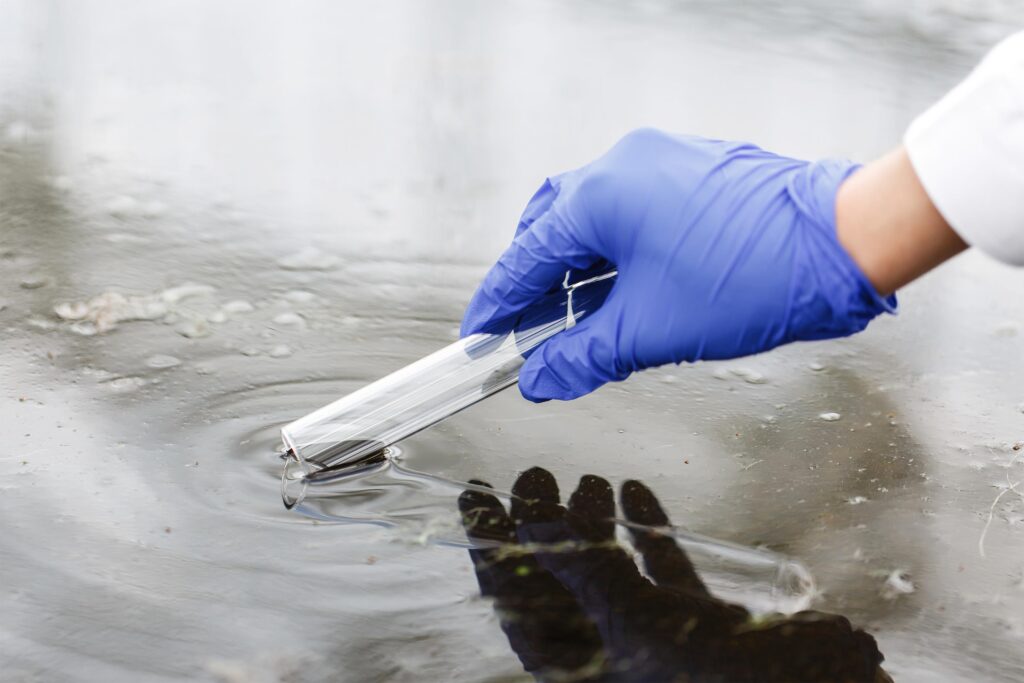
North Carolina Governor Josh Stein recently signed the State’s budget act (Senate Bill 257) into law, which includes the State’s new Water Safety Act. It authorizes a sweeping, two-phase sampling effort designed to identify sources of per- and polyfluoroalkyl substances (PFAS) discharges into North Carolina’s surface waters, along with a companion study on PFAS in biosolids. The North Carolina Collaboratory at UNC-Chapel Hill (the “Collaboratory”) will lead the research and ultimately deliver comprehensive recommendations for reducing PFAS loads from direct dischargers, indirect dischargers, and biosolids land application sites.
The Discharge Studies
Phase 1 targets publicly owned treatment works (POTWs) with at least one Significant Industrial User (SIU) and direct dischargers of process wastewater. Either the POTWs or the North Carolina Department of Environmental Quality (NCDEQ) will collect influent, effluent, and sludge samples. The Collaboratory will then analyze the samples for targeted PFAS, total oxidizable precursor (TOP), and adsorbable organic fluorine (AOF). Phase 1 sampling must be complete by December 31, 2027, with a report due to the General Assembly by March 31, 2028.
Phase 2 turns to indirect discharges from all SIUs statewide, with NCDEQ collecting influent and effluent samples and the Collaboratory conducting the same suite of analyses. This phase must wrap up by December 31, 2028, and a second report is due to the legislature by March 31, 2029.
Key Distinctions Between the Phases
Environmental practitioners should note important differences in how each phase’s data may be used. For Phase 2, the Act authorizes NCDEQ to retain “secondary samples” and use them for “regulatory actions” under the state’s approved Clean Water Act program. Phase 1 contains no such authorization. Moreover, Phase 1 data must be anonymized or aggregated by county or river basin, and facility-specific results are classified as exempt research data that is excluded from public records disclosure. Phase 2 data become public records after the Collaboratory publishes its report, though the Collaboratory retains discretion to treat them as exempt research data as well.
The Biosolids Study
The Act also authorizes research into the accumulation of PFAS in POTW biosolids, the environmental effects of land application, alternatives to land application, and the potential for new best management practices or treatment technologies to minimize PFAS in biosolids. A report on the biosolids study is due to the General Assembly by January 31, 2029.
Implications for the Regulated Community
While the short-term enforcement risk appears somewhat limited given the confidentiality protections for Phase 1 data and the Collaboratory’s discretion over Phase 2 data, by March 31, 2029, SIUs, direct dischargers, and POTWs will effectively be on notice regarding their PFAS contributions. Regulated entities should consider getting ahead of these studies rather than risk being caught flat-footed when data starts coming in. Practitioners should also advise clients to consider the implications of North Carolina’s findings for operations in other states and internationally.
Over the longer term, the studies appear more likely to support facility-specific PFAS minimization or reduction plans than water quality-based effluent limits, given the absence of non-point source PFAS load data for individual surface waters.