As some of you know, I am an avid fly fisherperson. My favorite fish to target is trout (catch and release of course). I’m also a board member of our local Trout Unlimited Chapter. Trout Unlimited (or TU) is the nation’s leading conservation organization caring for and recovering rivers and streams and their trout and salmon populations.
Trout require cold, clean and oxygen rich waters to survive, which necessitates protection of habitat that supports cold, clean and oxygen rich water. That includes limited development of land near trout streams, limited discharges (including thermal discharges) to trout streams, and limited withdrawal of ground and surface water from or near trout streams.
As a TU board member, I recently attended a TU northeast regional meeting. There was a fascinating, yet troubling presentation on the development of AI data centers and the impacts on trout and salmon. My most vivid takeaway was a slide that had an overlay map comparing the locations of TU designated priority waters and the locations of constructed and proposed data centers. You guessed it, many are co-located. (See presentation at: https://www.oregon.gov/energy/Get-Involved/Documents/2026-03-27-Means-Gray-Trout-Unlimited.pdf)
This is not terribly surprising since data centers need large tracts of land (some up to 1000 acres) and huge amounts of water for cooling systems and energy generation (up to millions of gallons of water per day depending on the size and design of the center).
Given the myriad of co-located data centers and trout waters, extreme precautions need to be taken in planning and constructing data centers.
My personal preoccupation with fly fishing and healthy trout habitat is, of course, emblematic of a greater concern we all need to share with respect to the many environmental effects from the construction and operation of data centers.
The Minnesota Chapter of TU recently cited the following effects of many data centers:
- high water use (both surface and groundwater)
- thermal pollution from cooling systems
- groundwater depletion
- energy demand and climate impact
- Poor siting of many centers in locations that can impact habitat
The Theodore Roosevelt Conservation Partnership, an organization that focuses on the habitat of many species beyond trout, also cited the fact that the construction of data centers and power transmission lines often require large footprints, which fragment and displace wildlife habitat. (https://www.trcp.org/2025/08/26/data-centers-energy-and-water-what-hunters-and-anglers-need-to-know/)
What is clear is that the rapid development of data centers across the country needs to be better managed at the federal level. Most data center development projects are approved at the local municipal level like any other development project, by local municipal elected officials who may not be equipped to deal with such large-scale projects with such widespread water and energy needs. Furthermore, many municipal ordinances were not developed to regulate such massive projects, some of which span multiple municipalities. Moreover, most municipalities don’t have the resources to regulate such projects given the potential for litigation by either developers or opponents (or both).
It seems unlikely that the current administration will put the brakes on the development of data centers in order to develop meaningful, comprehensive, and sensible guidelines and regulations. The opposite seems to be the case. Many states have begun to regulate data center development. The Governor of NY recently issued an executive order that implements a temporary moratorium on the construction of most hyperscale data centers pending the development of better standards for development and a blueprint to support local municipalities. (https://www.governor.ny.gov/executive-order/no-62-establishing-temporary-moratorium-data-centers-new-york-while-state-develops) However, it remains to be seen how such efforts will be decided by courts.
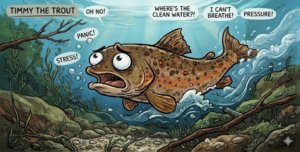
Sadly, trout may be the “canary in the coal mine” when it comes to the environmental effects of data centers.(Ironically, I used AI, running off of some nearby data center, to generate the above cartoon…)