What happens when an emerging industry decides to secede from the power grid?
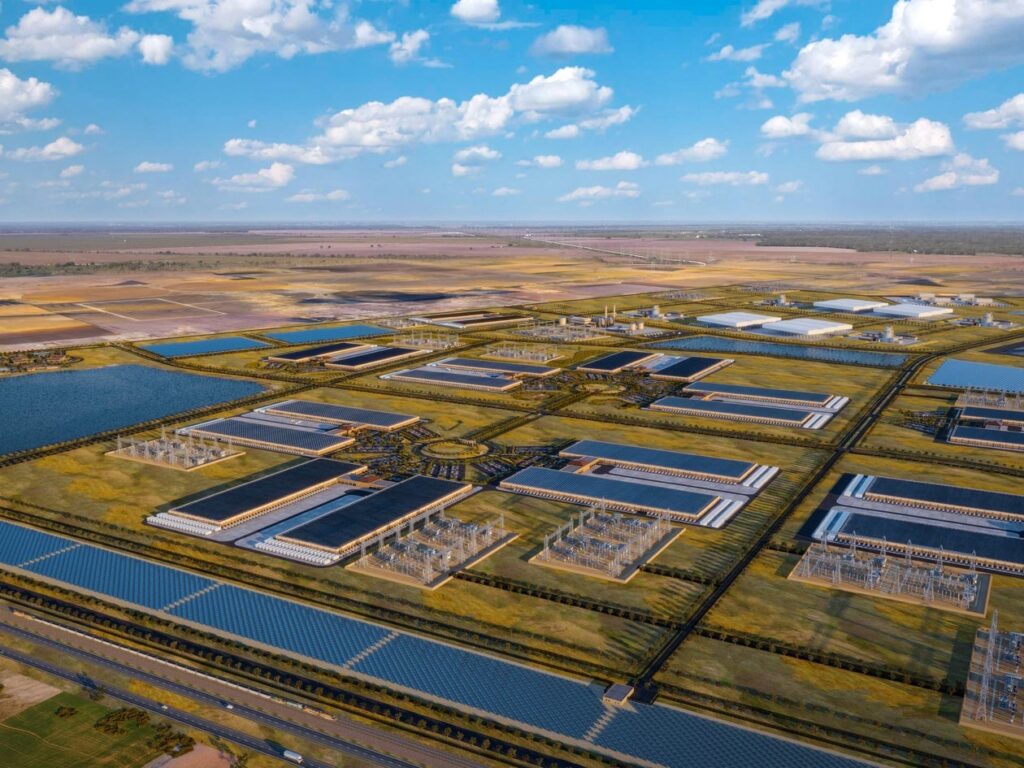
In Pecos County, deep in West Texas’ Permian Basin, a data center developer claims to hold the largest power-generation air permit in the United States. According to Pacifico Energy, the Texas Commission on Environmental Quality has authorized 7.65 gigawatts of gas-fired generation on a single ranch (paired with batteries and solar) to power hyperscale data centers. In February, TCEQ commissioners gave final approval for the nation’s second-largest Clean Air permit to a different developer for Project Matador, authorizing the use of 90 Siemens combustion turbines at a site outside Amarillo. A month later, that same developer sought air permits to add another five gigawatts of generation capacity that would expand its planned private grid to nearly 17 gigawatts, including proposed nuclear, solar, and battery capacity.
None of these power generation facilities will ever appear in the list of proposed power projects seeking to connect to the Texas electric grid (the “interconnection queue”) operated by the Electric Reliability Council of Texas (ERCOT). They instead will run around the clock to feed artificial intelligence workloads. And the agency that Texas empowered to permit refineries and petrochemical complexes has found itself, without ever asking for the job, serving as a principal state regulator of AI infrastructure siting.
Why and how did the meter move? As usual, the numbers tell the story. In a recent white paper on the Texas grid, the University of Houston projected that data centers and other large loads could push statewide electricity consumption up 75 to 300 percent by 2035. This sudden increase in demand would leave an annual capacity shortfall of roughly 27 GW—and potentially 40 GW—unless the state makes major investments in new power generation and transmission infrastructure. This jump in projected demand led to expected infrastructure constraints, with ERCOT’s large-load interconnection queue exceeding 56 GW, transmission expansion projects facing five-to-seven-year timelines, and lead times for heavy-duty gas turbines extending into the 2030s. As a result, data center developers, whose standard business models have depended on “five nines” (99.999%) of reliable uptime, began to co-locate power generation on site long before the Texas Legislature weighed in.
But when the Legislature finally weighed in, it laid a heavy hand on the industry. Senate Bill 6, signed in June 2025, sought to protect ERCOT ratepayers from stranded infrastructure costs and to give the grid operator emergency leverage over large loads. SB 6 added new Section 37.0561 to the Texas Public Utility Regulatory Act (PURA) authorizing ERCOT, during grid emergencies, to direct facilities with large power loads that include substantial non-exporting on-site generation to curtail or to deploy that generation. In essence, ERCOT can reach into the facility and commandeer its power assets in emergencies. Additionally, new §§ 39.169 and 39.170 now empower ERCOT and the Public Utility Commission of Texas (PUCT) to review and approve attempts by developers to co-locate their facilities with existing grid-facing generators. The agencies can also require curtailment-capable equipment for loads interconnecting after 2025.
As a result, the price of grid membership for these data centers has begun to rise sharply: the PUCT’s draft rule in the Texas Administrative Code (16 TAC § 25.194), published in March with adoption expected this summer, would impose six-figure study fees, full contribution-in-aid-of-construction obligations, and financial security postings of $50,000 per megawatt with steep forfeiture provisions. On June 18 the PUCT approved ERCOT’s “Batch Zero” process for triaging the large-load requests already in line. SB 6 may not have spurred a flight from the Texas grid, but it certainly converted a queue-avoidance tactic into a full secession strategy. Under the new Texas regulatory regime, a wholly islanded private grid (like the Pecos County campus) now escapes ERCOT’s curtailment authority, its interconnection costs, and its multiyear studies altogether.
These power archipelagos, however, cannot escape the Clean Air Act. Large power facilities at data centers can still emit enough criteria air pollutants or hazardous air pollutants to constitute major sources under the federal and Texas Clean Air Acts, and even smaller sources may need to comply with Texas rules for standard permits or permits by rule. That trade, however, remains remarkably favorable for developers because Texas air permitting offers a ladder whose rungs can emphasize speed. The smallest sources, for example, might rely on permits by rule. Data centers’ emergency diesel arrays—sometimes dozens of engines totaling more than 150 MW at a single site—could qualify under 30 TAC § 106.511 with no individual public notice and no opportunity for a hearing. Moving to the next rung, standard permits for electric generating units under Texas Health & Safety Code § 382.05195 would offer a streamlined registration process to authorize nominally minor sources within weeks. Because the public participated (if at all) when TCEQ adopted the underlying standard permit in 2007 (with a natural-gas-engine variant added effective January 30, 2025), individual registrations draw neither notice nor contested case rights. As a result, the Environmental Integrity Project now estimates that two dozen of the roughly 130 gas plants now proposed in Texas will take advantage of this expedited route. At the top rung, even full PSD review can move at a pace that would impress practitioners in other delegated states. For example, TCEQ reportedly granted one 519 MW reciprocating-engine plant its permit three weeks after application, aided by an expedited-processing program under Texas Health & Safety Code § 382.05155 that lets applicants pay surcharges to fund overtime and contract reviewers.
As environmental and energy practitioners, we’re typically accustomed to working with siting boards, energy facility councils, and environmental impact reviews. Texas, however, uses a different and tailored process. With no state siting statute, no state environmental policy act, and no TCEQ jurisdiction over noise or, in most respects, groundwater pumping, TCEQ’s preconstruction air permit process as a practical matter offers the primary state approval that can affect these multi-gigawatt private power campuses. Most of the siting conflicts that other states distribute across several proceedings therefore, in Texas, funnel into an air permitting process that the state never designed to carry such weight. Nor are the stakes merely local: modeling published this year in Environmental Research Letters suggests that data center and cryptocurrency growth could raise U.S. power sector CO₂ emissions 13 to 28 percent by 2030. Nearly half the gas-plant capacity now proposed in Texas would power data centers directly.
This farrago has led to an ironic result. Texas has spent three decades deregulating its electricity market precisely so that generation decisions would answer to markets rather than regulators. But in 2026, efforts to protect ratepayers and reassert control over large loads have spurred developers to migrate to off-grid power models—i.e., facilities whose primary regulatory handholds are environmental permits designed for entirely different purposes. TCEQ’s permitting speed may not survive if future circumstances change with EPA oversight under a future administration, litigation over potential-to-emit, a new Texas appellate court, and revived assertion of hearing rights by rural communities. The hyperscalers may have pirouetted from one regulator’s queues and curtailments, but their move has left environmental lawyers at the forefront of the next great siting fight in American energy law.