posted on November 24, 2025 by Jim Salzman
Ecologists often decry a problem known as “shifting baselines.” The kelp forests, whales and sea otters around Monterey Bay we witness today are extraordinary. But if you asked someone who had lived in the area 40 years earlier, they would say that today’s sea life is only a shadow of how amazing it used to be. And someone who had witnessed the area even 40 years earlier would say the same about how much more magnificent it used to be.
The problem is that we tend to take the present as the baseline, not recognizing what has been lost. I certainly found this to be true when trying to describe to my kids how much more dramatic the flickering lights of fireflies were in our backyard when I was their age.
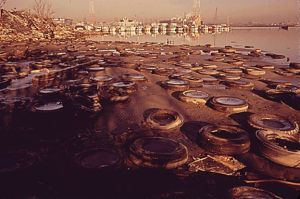
The reverse can happen, as well. Growing up in the 1970s, piles of trash lined highways and tires washed up on riverbanks. Keep America Beautiful’s famed “Crying Indian” commercial made this tragically clear (despite later being revealed that the actor was of Italian ancestry). When Time magazine declared “Lake Erie is a dead lake” or named “The Endangered Earth” as its Planet of the Year, it was no joke. Cleveland’s Cuyahoga River famously caught fire in 1969, but it was the 12th time it had burned in a century.
Just as we tend to forget how much more vibrant the natural environment was, there is an amnesia about how polluted things were. It is particularly hard to get this across in the classroom.
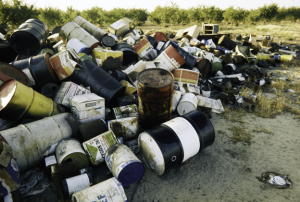
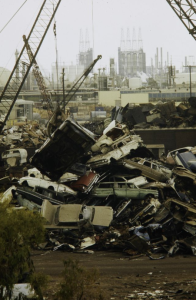
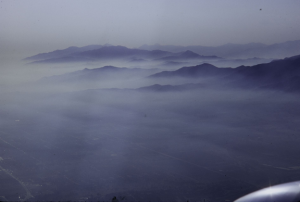
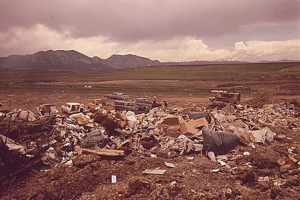
That’s why I was excited to learn recently about the Documerica project, courtesy of a wonderful photojournalist article by Gideon Leek. Conceived by Bill Ruckelshaus during his first stint as EPA Administrator, Documerica was inspired by the famous photographs of depression-era farmworkers in the 1930s by the Farm Security Administration. Ruckelshaus’ newly-created agency commissioned a nationwide photo record in order to, as Leek describes, “provide the EPA with a great deal of qualitative environmental data, create a ‘visual baseline’ against which to judge their efforts, and introduce the agency to the country through art.”
In its five years of operation, it produced over 20,000 photographs, from rivers and farms to highways and city streets. The photos provide a vivid window into the state of the environment in the 1970s.
For me, they are at once sobering and inspiring. They bring back memories from my childhood of how we took pollution and trash for granted, and a reminder of why many of us went into this field. It provides an important baseline of the conditions that led to the Modern Era of environmental law and shows how much has been achieved.
I have pasted below some of the striking photos, but it is well worth checking out yourself. I’d recommend you start with Gideon Leek’s article explaining the Documerica Project. For more detail, you can view the photos by category here or searchable here.
Environmental laws and regulations are often popular political targets, perhaps now more than ever before, but Documerica’s photos provide a simple rebuttal – showing just how far we’ve come, and the loss we risk through forgetting.
All images are courtesy of Wikipedia.