
Posted on April 28, 2025 by David B. Farer
The fifth delegation of ACOEL Fellows from the International Pro Bono Committee’s Cuba Working Group have participated in our latest project in Havana, a four-day event from March 24-27, 2025 developed and presented by ACOEL in conjunction with two Cuban foundations, with the participation and support of the Cuban Environment Agency.

The meetings included the signing of two Memorandum of Understanding documents with the Cuban foundations: a new five-year MOU between the College and the IRIS Climate Foundation in Cuba, one of the sponsors of the event; and a five-year MOU extension between the College and the Foundation Antonio Nunez Jimenez of Nature and Humanity (FANJ), with which the College entered its first Cuba-based MOU in 2019. FANJ was also a sponsor of the event.

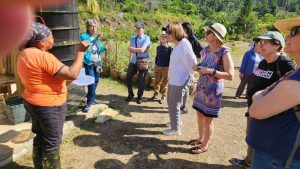
The events consisted of three full days of meetings, workshop panels and exchanges at the National Aquarium of Cuba in the Miramar neighborhood of Havana, and a final day comprised of visits, with our Cuban counterparts, to communities in the Sierra del Rosario mountains about an hour’s drive west of Havana, including a biosphere reserve featuring eco-restoration projects. The event was titled “USA-Cuba Key Environmental Issues: Lessons Learned – Lessons Shared.”
The ACOEL delegation consisted of Elizabeth Andrews, John Dernbach, Rob Kirsch, Lewis Jones, Walker Smith and me.
The ACOEL Foundation provided well-appreciated underwriting of particular administrative expenses for presentation of the event, as well as modest stipends to the faculty to help off-set some of the travel costs and out of pocket expenses incurred while in Havana.
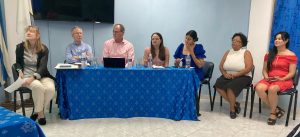
On the Cuban side, there were seven participants from IRIS, two from FANJ, fourteen from the Cuban Environment Agency known as AMA, five from CITMA, which is the Ministry of Science, Technology and Environment within which AMA operates, and additional participants and guests including faculty from the University of Havana Law School and representatives from the Institute of Philosophy, the Ministry of Foreign Affair and the Ministry of Agriculture. In all, there were approximately forty Cuban participants.
The AMA representatives included the head of that agency, and the CITMA representatives included the Legal Director (who is also a professor at the University of Havana) and the General Directorate of Environment there. AMA also brought in representatives from a number of provinces around the country, as well as senior representatives from various AMA Institutes. We had an excellent translator for the entire set of events.
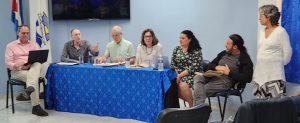
The topics for the three days of exchanges, as specified on the Program Agenda, had been developed based initially on recommendations identified at the end of our 2023 joint symposium in Havana with FANJ, and then further revised and refined during subsequent meetings with staff at the Cuban Embassy in Washington, D.C., and with IRIS, both of which also consulted with AMA. Each panel and discussion involved both Cuban and US faculty participants.
On the final day of panels, there was a substantial concluding session on developing a roadmap for next steps over the next five years. On topics to further pursue in future meetings, there was a broad array of suggestions that IRIS will be summarizing and building into categories, and which included energy transition, methods to deal with climate change and biodiversity, community empowerment, managing urban waste, recycling, environmental and social safeguards, marine protection, urban tree protection and propagation, and more in general on most of the topics we addressed at the Aquarium meetings.
In terms of when, where and how to proceed and meet, our Cuban colleagues suggested the goals for further in-person meetings, and in the interim continuing momentum by way of video-conferences, as we did during Covid. They also suggested the potential for joint research papers. We will be following up on all of this.
On our final day, while we were at the Ecological Station for the Sierra del Rosario community, all of the ACOEL Fellows donated the items we had brought with us for the Cuban people: well-needed items in short supply there and which we take for granted here, such as bandages, antibiotic ointment, aspirin, Advil, Tylenol, vitamins, toothpaste and toothbrushes, shampoos and other necessities, as all of the Fellows have done during each of our four prior Cuba delegations.
Thank you for the support of the Foundation and the College on this important delegation, which has deepened our relationships with our Cuban counterparts, and our work there.