
Posted on April 23, 2025 by Jeff Civins
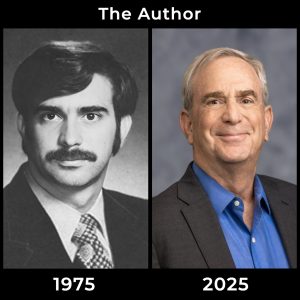
Growing up in Irvington, NJ, near refineries, chemical plants, and other industrial facilities, I never imagined that one day I’d end up being an environmental lawyer, and in Austin, Texas. This year marks my 50th year practicing environmental law. It’s a good time to reflect.
In 1967, I graduated from Brandeis University and worked that summer in Edison, NJ as an analytical chemist for one of EPA’s predecessors—the Federal Water Pollution Control Administration, not appreciating any potential relevance to my future profession. That fall, I became a chemistry graduate student at Penn State, working as a teaching assistant. Two years later, I began a 3-year stint, teaching science, chemistry, and earth science at public and private schools in NYC.
In NYC, I met my wife, Katy, a graduate student at Columbia, and we jointly decided to apply to law schools—in NYC, DC, and Boston. Somehow, we landed at the University of Texas in Austin, Katy, being from Oklahoma, might have had some impact on that decision-making; the only part of Texas I’d seen before was the panhandle, driving up to Colorado on our honeymoon. We’ve been in Texas ever since. UT Law was (and is) an exceptional law school; remarkably, tuition back then was even less than the cost of our textbooks.
In applying to law school, I touted my science background and mentioned my interest in environmental law, but UT Law then offered no classes in it. During on-campus interviews as a 3L, I serendipitously happened to meet the chair of Vinson Elkins’ environmental practice group, which then comprised 4 lawyers. I thought those folks would be great to work with (and they were), and, in May of 1975, I joined them in Houston. It was a fortuitous decision, because I’ve enjoyed the practice of environmental law ever since, helping clients address environmental issues. It’s a practice that is both constantly evolving and highly eclectic, involving different aspects of the practice of law, different environmental laws and media, different types of clients, and different scientific disciplines.
My practice has always been a mix—of regulatory counseling, transactional work, and litigation. When I started, we encountered virtually all environmental statutes focusing on regulatory compliance, permitting, and rulemaking. In 1975, the laws were far fewer and far simpler. With the enactment of the Texas Administrative Procedure Act in 1975, we began doing contested case permit hearings before administrative law judges. With the advent of Superfund in 1980, our practice expanded to include not only representing clients in Superfund litigation, but also helping our corporate and real estate clients identify and manage risks associated with contaminated properties and facilities. More recently, we’ve also been advising on matters involving newly minted acronyms such as GHGs, ESG, CCS, EPR, and PCR.
As an environmental lawyer, I’ve worked with and learned about a wide range of industries. At one time, I represented a hamburger chain in Houston, an oil shale project in Utah, and a coal gasification plant in Kentucky. Over the years, I’ve gotten to do site visits of a wide spectrum of businesses, including: refineries; power plants: municipal and industrial wastewater treatment plants; municipal and hazardous waste landfills and incinerators; airports; marine terminals; breweries; wood treating facilities; manufacturing facilities making a variety of products, including chemicals, steel, aluminum, gypsum, beverage cans, glass bottles, fertilizer, and batteries; rendering plants; offshore and onshore oil and gas facilities; compressor stations and pipelines; big box wholesalers; gold, copper, sand, and silver mines; artificial swimming lagoons; and real estate developments and projects of all types.
I’ve also been privileged to work with and learn from experts from many fields, including biologists, chemists, physicists, geologists, hydrologists, civil, chemical, petroleum, and environmental engineers, physicians, toxicologists, air and water quality experts, biologists, and land use planners. Having a science education has been a plus, and I’m fortunate in being able to continue that education in my practice.
In 1984, we returned to Austin. In 1990, I had the chance to start up a new environmental practice at a VE spinoff, Kelly Hart & Hallman, with which I’d previously worked. And in 1990, our practice group, wooed by Greg Cooke, who later became Regional Administrator for EPA Region 6, we joined Haynes and Boone, where I’ve happily been ever since. I had the chance also to go back to teaching— at UT Law in 1987 and later again in 1992, when I began teaching a seminar on environmental litigation, which I’ve done each spring since. I’ve enjoyed the chance also to share my thoughts on environmental issues, not only in teaching, but also in writing and speaking at conferences.
I’ve had my fair share of memorable matters to work on. Some representations that stand out include: the named PRP—one of only a handful including the federal government—at the Marathon Battery Superfund site on the banks of the Hudson River; 2 of 7 of the first NPDES discharge permittees in the Gulf of Mexico in a contested EPA permit proceeding; the developers of a proposed deepwater port and marine terminal in Galveston in an air quality permitting contested case hearing and appeal; the Department of Treasury in doing environmental due diligence on new GM; various underwriters in doing environmental due diligence on TXU’s power plants in conjunction with its proposed acquisition by investment groups; UTMB in the NEPA review of its Biosafety Level-4 laboratory facility; the State of Texas, working alongside DOJ, in Clean Water Act enforcement actions against an independent energy company for 300 oil spills in 6 states; and American Airlines, in United Airlines’ bankruptcy regarding contamination at JFK Airport.
I’ve worked with talented lawyers at 3 different firms. I’ve also been a proud member of the vibrant and collegial Environmental and Natural Resources Law Section of the State Bar of Texas, which is over 1,200 members strong. I’ve worked with many of our members on the annual Texas Environmental Superconference, known not only for having quality programming, but also for being fun—having themes, bad puns, songs, skits, quizzes, and prizes. I blogged about the conference on this website a number of years ago. This year’s conference, our 37th, with a theme related to candy, is entitled “How sweet it is.” We, as a section, since 1997, also have worked with Thomson Reuters to publish an annual 2-volume treatise on Texas Environmental Law, presently comprising 39 chapters written by 50 section members.
I was fortunate at the start of my career to have been mentored by two exceptional environmental lawyers—Carol Dinkins and Norm Radford. Over the years, I’ve tried to be a mentor as well—to high school, college, and law students as well as to younger lawyers, in addition to mentoring through teaching.
In 2020, I was asked by my alma mater, Brandeis, to share my views with students on a number of environmental topics. My title, which was posted during the COVID crisis, reflected the notion of seeking common ground. Although that crisis has passed, we face others. My thoughts then I believe are relevant now, so I’ve excerpted some of them below.
The pledge by major companies to protect the environment through sustainable business practices and their acknowledgment that they are responsible to all their stakeholders, not merely their shareholders, was the latest milepost on an evolution of corporate culture. From a focus on environmental compliance to risk management to environmental sustainability, companies have come to recognize that being environmental stewards, protecting the environment, is both appropriate and good for business. [The COVID] crisis … should have created an awareness for corporations, and others, that there are less environmentally impactful ways of conducting business, that identifying and planning for worst-case scenarios is critical, and that our economy, including our supply chains, is linked to what happens in the rest of the world.
I encourage students to be willing to think big and outside the box and to forcefully advocate for your positions, but to embrace a spirit of civil dialogue around environmental issues. Be willing to talk with those whose perspectives differ from yours: explore goals on which you can agree and discuss how best to achieve those goals.
Regardless of where people stand on the political spectrum, presumably there’s much they can agree on, for example: reducing the quantity and toxicity of waste; conserving natural resources and water; building an adequate infrastructure to manage potable water and wastewater; and making energy available while protecting the environment.
Recognize that environmental dialogue and decision-making should be based on science and fact, not political ideology.